

Hardwired
The fiction writer's lesson in the coolest novel you've never read

THAT FEELING WHEN I encounter a novel that’s truly original. How it shocks, thrills, and inspires, pours jet fuel on the embers of my motivation.
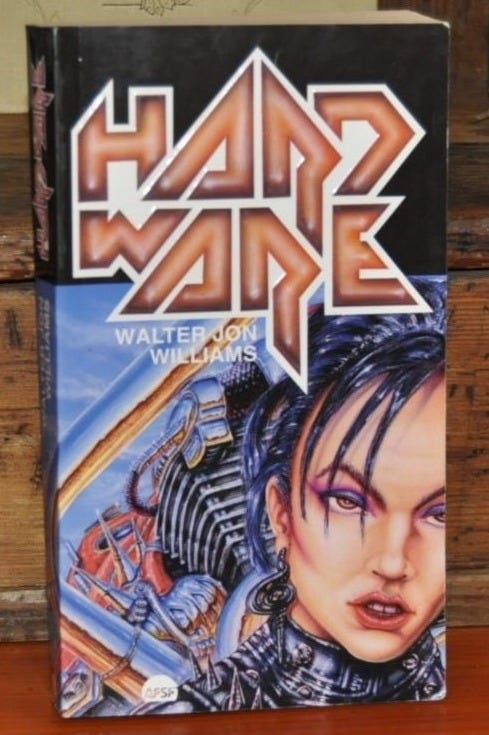
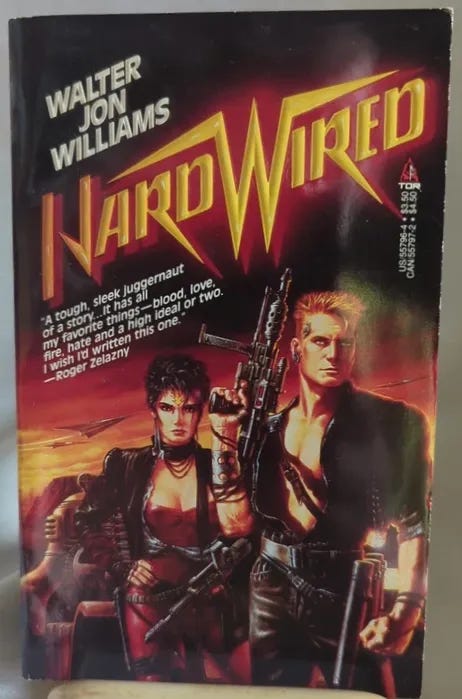
Walter Jon Williams’ 1986 cult classic Hardwired is that kind of book. A pillar of cyberpunk, this visionary science-fiction novel conjures, like a nightmare digitized, a society so corroded by capitalism and climate change it has rotted through.
Distant dreams are human rights, arts and culture, rule of the people or even of the state. A world dominated by global tech corporations that rule from stations that orbit the Earth. A society where only the strong survive and ruthless succeed.
Our world, almost.
As Williams says in the introduction to the 30th Anniversary Edition:
“People sometimes ask me if I’ll write something like Hardwired ever again. I tell them I can’t, because too much of that future came true.”
Here is the back-cover description:
Years ago, the last desperate hopes of Earth were crushed as corporate Orbital blocs ruling from on high devastated the planet’s face. Today, the autocratic Orbitals indulge in decadent luxury far above the mudboys, dirtgirls, zonedancers, and buttonheads who live out violent lives of electronic distraction and dependence amid the flooded, ruined cities and teeming slums of a balkanized America.
But there are heroes; those who would stand against the Orbital powers and keep freedom’s cause alive. Two such heroes are the metal-eyed ex-fighter pilot turned panzer-driver Cowboy, and Sarah, the cybernetic assassin desperate to find a better life for her drug-addicted brother. Together, Cowboy and Sarah embark on a high-octane odyssey across the shattered face of the American west.
IN FICTION LESS is more. Dense description can be sublime, and there are times when dense is exactly what you need, but lean, mean, and clean can always punch the reader in the gut. The most page-turning books are often the most economical, the least prone to explaining themselves.
Williams’ refusal to explain almost anything is exactly why Hardwired is so thrilling and immersive. Reading it feels like discovery. As anyone who’s ever played an RPG video game (like Cyberpunk 2077, which was directly inspired by Hardwired) understands, mystery compels action: The player moves the character forward through the world precisely because each successive quest answers, in whole or in part, one question as it presents another. Discovery is the reward, and it is thrilling.
Williams’ worldbuilding is minimal, precise. It’s in the granular details and hypervivid imagery, the brilliant compound nouns he sprinkles throughout and rarely elaborates upon: Zonedance. Panzerboy. Dirtgirl. Buttonhead.
His prose is electric: confident and stylized and dripping with cool. Reading it feels like jacking in to the matrix.
Williams establishes the voice immediately, in the opening paragraph:
By midnight he knows his discontent will not let him sleep. The panzerboy drives north from Santa Fe, over the Sangre de Cristos on the high road through Truchas, heading for Colorado, wanting to get as close as possible to the night sky. He drives without the use of hands or feet, his mind living in the cool neural interface that exists somewhere between the swift images that pass before his windscreen and the electric awareness that is the alloy body and liquid crystal heart of the Maserati. His artificial eyes, plastic and steel, stare unblinking at the road, at twisting dirt ruts corrugated by the spring runoff, tall stands of pine and aspen, high meadows spotted with the frozen black shapes of cattle, all outlined in the rushing, almost liquid light of his high beams as he pushes the Maserati upward. The shapes that blaze in the headlights stand boldly against the darkness of their own shadows, and Cowboy can almost see himself in a monochrome world like a black-and-white celluloid image projected before his windscreen, flickering with the speed of his passage.
You can feel it. The throb of the engine. The cold rush of the neural interface. It’s vivid and slick and it doesn’t fuck around.
Stories which envision the world anew can buckle under the weight of themselves, but Williams keeps it moving, never allowing his vision for the future to become an excuse to proselytize. Storytelling pure and true—take it or leave it.
FOR ME, THE scene that illustrates why Hardwired is a cult classic occurs thirty-some pages in. It’s a sex scene between a professional killer and her mark, an obscenely rich elderly man whose consciousness is inhabiting the body of a young woman.
Though it’s not quite the sex that makes this scene so memorable.
Danica laughs and lies back on sheets that match her eyes, arms outstretched. Sarah bends over her and laps at her palate. Danica moans softly, approval. She is an old man and a powerful one, and Sarah knows his game. His job is to rape Earth, to be as strong as spaceborne alloy, and it is weakness that is his forbidden thing, his pornography. To put his bright new body into the hands of a slave is a weakness he wants more than life itself.
“My dream,” Danica whispers. Her fingers trace the scars on Sarah’s cheek, her chin.
Sarah takes a deep breath. Her tongue retracts into its Weasel’s implastic housing, and the cybersnake’s head closes over it. She rolls Danica entirely under her, holding her wrists, molding herself to the old man’s new girl-body. She presses her mouth to Danica’s, feeling the flutter of the girl’s tongue, and then Weasel strikes, uncoiling itself from its hiding place in Sarah’s throat and chest. Sarah holds her breath as her elastic artificial trachea constricts. Danica’s eyes open wide as she feels the touch of Weasel in her mouth, the temperature of Sarah’s body but still somehow cold and brittle. Sarah’s fingers clamp on her wrists, and Princess gives a birth-strangled cry as Weasel’s head forces its way down her throat. Her body bucks once, again. Her breath is hot and desperate in Sarah’s face. Weasel keeps uncoiling, following its program, sliding down into the stomach, its sensors questing for life…. Princess moans in fear, using his strength against Sarah’s weight, trying to throw her off. Sarah holds him crucified. Weasel, turning back on itself as it enters her stomach, tears its way out, seeks the cava inferior and shreds it. Danica makes bubbling sounds, and though she knows it is impossible, although she knows her tongue is still retracted deep into Weasel’s base, Sarah thinks she can taste blood. Weasel follows the vein to Danica’s heart.
It’s a great scene. You can read the entire chapter on Williams’ website.
It’s a great scene because it surprises you. We know Sarah plans to kill Danica, but not in a million years could we have guessed how she would do it.
Therein lies the lesson of Hardwired: Surprise the reader.
The reader expects A or B, so give them C.
Give them a cybersnake for a weapon concealed inside a woman’s throat.